
CPS Test
CPS Firefighter Mechanical Aptitude Practice Questions
Challenge yourself with hard CPS firefighter mechanical aptitude practice questions covering gears, pulleys, levers, ramps, and core formulas you should know before test day.
The CPS firefighter test can include mechanical aptitude questions that assess how well you understand basic physical principles, simple machines, motion, force, and practical problem-solving.
For many candidates, this is one of the hardest sections because it combines visual reasoning with mental math. You may need to look at a gear system, pulley setup, lever, or ramp and quickly decide what happens to force, speed, direction, or mechanical advantage.
In this guide, you'll find:
- The mechanical formulas and concepts worth knowing
- The supporting math skills that matter most
- Five hard CPS-style practice questions with full explanations
- The most common mistakes candidates make under time pressure
If you want full timed practice, section-by-section training, and realistic firefighter aptitude tests, explore the free practice test or the full CPS practice tests at Firefighter Academy.
What to Expect in Firefighter Mechanical Aptitude Questions
Mechanical aptitude questions often test your understanding of:
- **Levers** and turning effect (torque)
- **Pulleys** and rope systems
- **Gears** and gear trains
- **Belt drives** (open and crossed)
- **Ramps / inclined planes**
- **Mechanical advantage**
- **Force and distance trade-offs**
- **Direction of movement or rotation**
- **Basic arithmetic and algebra** inside mechanical problems
You do not need advanced physics. What you do need is a clear grasp of the core rules and enough math comfort to apply them under time pressure.
Mechanical Aptitude Formulas and Rules to Know
Here are the most useful formulas and concepts to review before test day.
1. Rate, Time, and Distance
These are common supporting math skills and show up in work-rate style questions.
- `Rate = Distance ÷ Time`
- `Distance = Rate × Time`
- `Time = Distance ÷ Rate`
If someone runs 4 km in 3 minutes, their rate is 4 ÷ 3 km/min. To find how far they run in 10 minutes: (4 ÷ 3) × 10 = 40 ÷ 3 = 13.33 km.
2. Lever Formula
For a balanced lever: Effort × Effort Distance = Resistance × Resistance Distance, often written E × ED = R × RD.
- **Effort** — the force you apply
- **Effort Distance** — distance from the fulcrum to where the effort is applied
- **Resistance** — the load
- **Resistance Distance** — distance from the fulcrum to the load
3. Ramp / Inclined Plane Formula
Ignoring friction, ramps follow the same work principle: Effort × Ramp Length = Resistance × Ramp Height, or E × L = R × H.
A longer ramp reduces the force needed, but you must push over a greater distance.
4. Pulley Rule
For an ideal pulley system: Mechanical Advantage = the number of rope segments supporting the load, so Effort = Load ÷ Mechanical Advantage.
If 4 rope segments support the load, the force required is about one-quarter of the load. The trade-off: you must pull more rope.
5. Gear Formula
A reliable way to solve gear-speed questions: Driver RPM × Driver Teeth = Driven RPM × Driven Teeth, so Driven RPM = Driver RPM × (Driver Teeth ÷ Driven Teeth).
Key rules:
- A **small driven gear spins faster**
- A **large driven gear spins slower**
- **Meshed gears rotate in opposite directions**
- An **idler gear** changes direction but does not change the overall ratio by itself
- **Gears on the same shaft** rotate at the same RPM and in the same direction
6. Belt Drive Rules
- Speed ratio works the same way as gear ratio
- A **smaller driven pulley spins faster**
- A **larger driven pulley spins slower**
- With an **open belt**, both pulleys rotate in the **same** direction
- With a **crossed belt**, the pulleys rotate in **opposite** directions
7. Percentages
- `Percent = (Part ÷ Whole) × 100`
- `Percent Change = (Change ÷ Original) × 100`
Example: if a shaft drops from 200 RPM to 150 RPM, the change is 50. 50 ÷ 200 = 0.25 = 25%, so the speed decreased by 25%.
Supporting Math Skills You Should Be Comfortable With
Even in mechanical aptitude, candidates often need solid basic math:
- Basic algebra
- Long division
- Multi-digit multiplication
- Fractions
- Ratios
- Percentages
- Unit conversions
- Mental math under time pressure
If your mechanical reasoning is decent but your arithmetic is slow, this section will still feel difficult. That's why realistic, timed practice matters.
5 Hard CPS-Style Mechanical Aptitude Practice Questions
These are real questions pulled from our CPS practice test bank. Work each one out before revealing the answer.
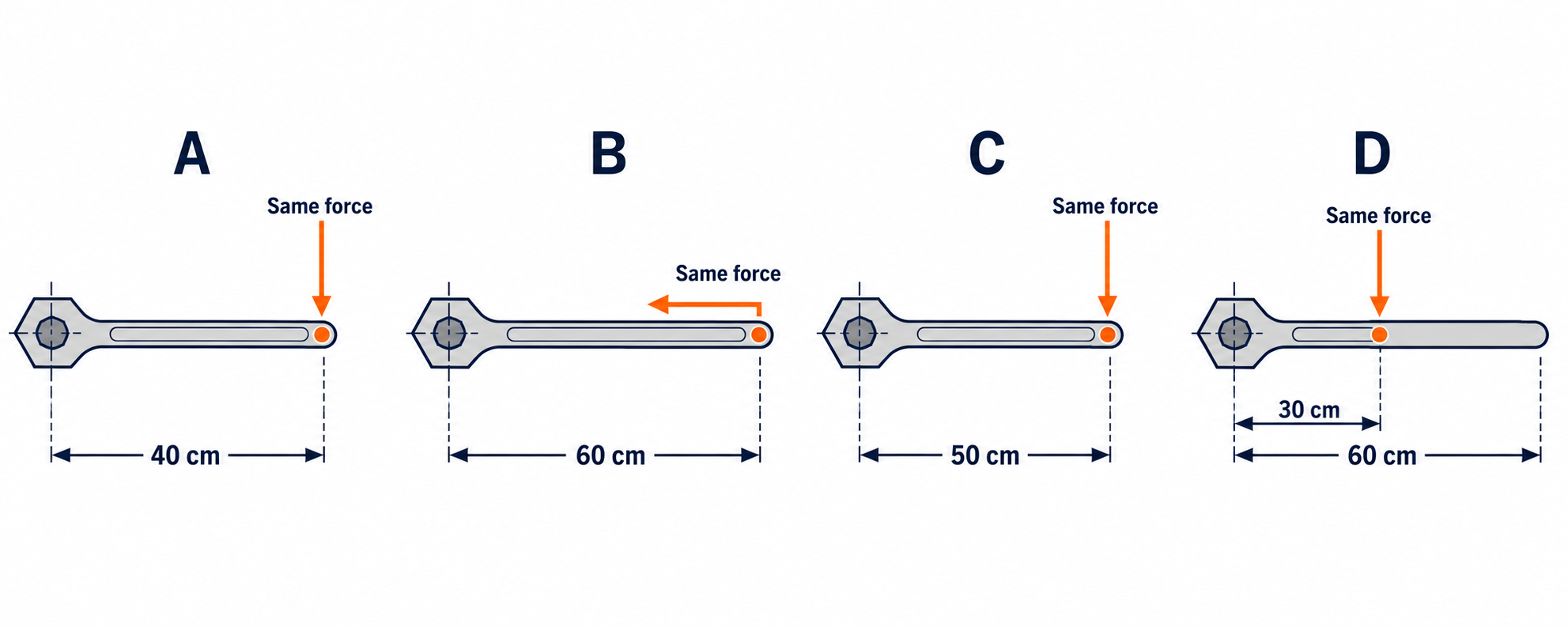
- AArrangement A
- BArrangement B
- CArrangement C
- DArrangement D
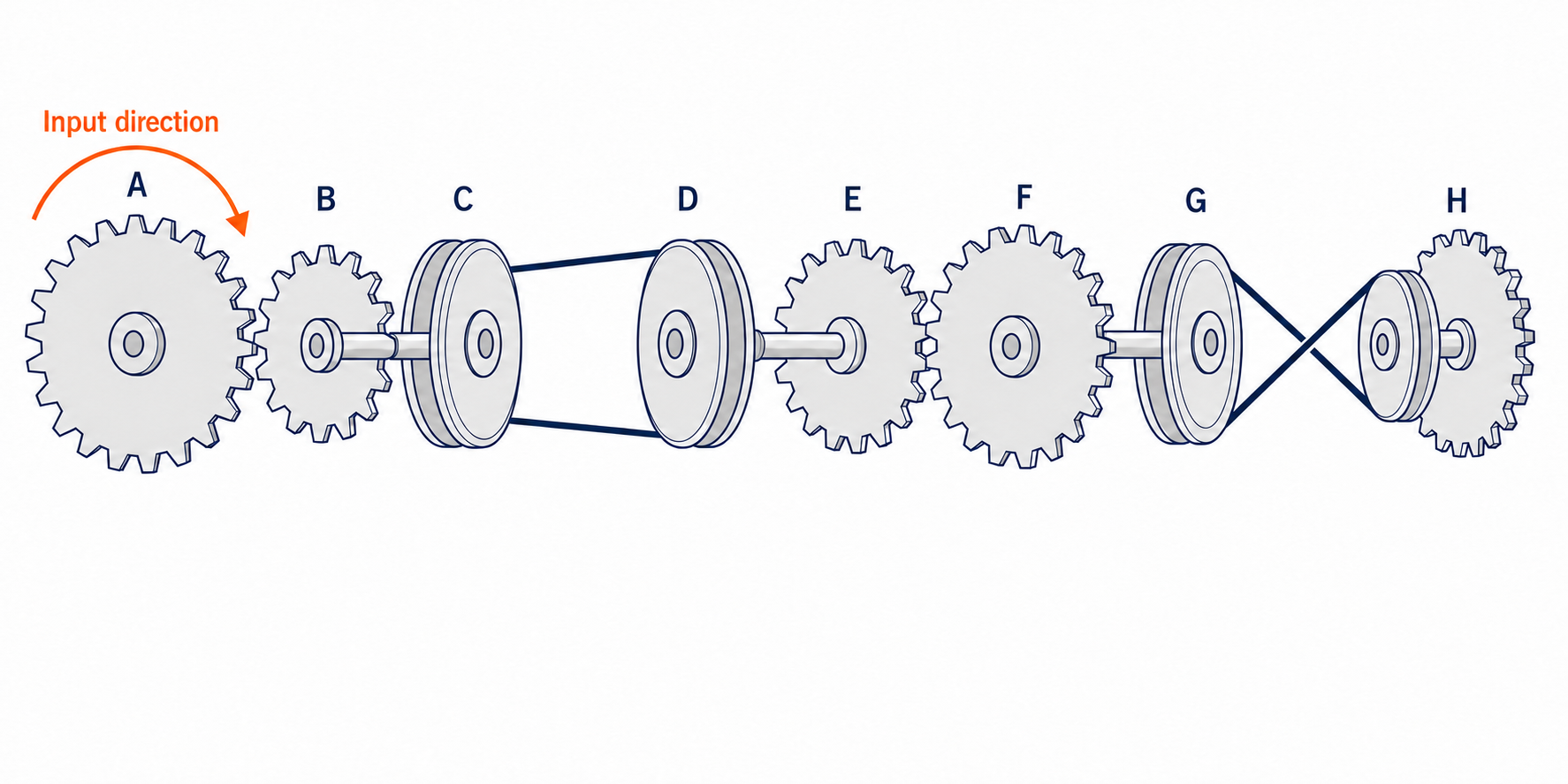
- AClockwise
- BCounter-clockwise
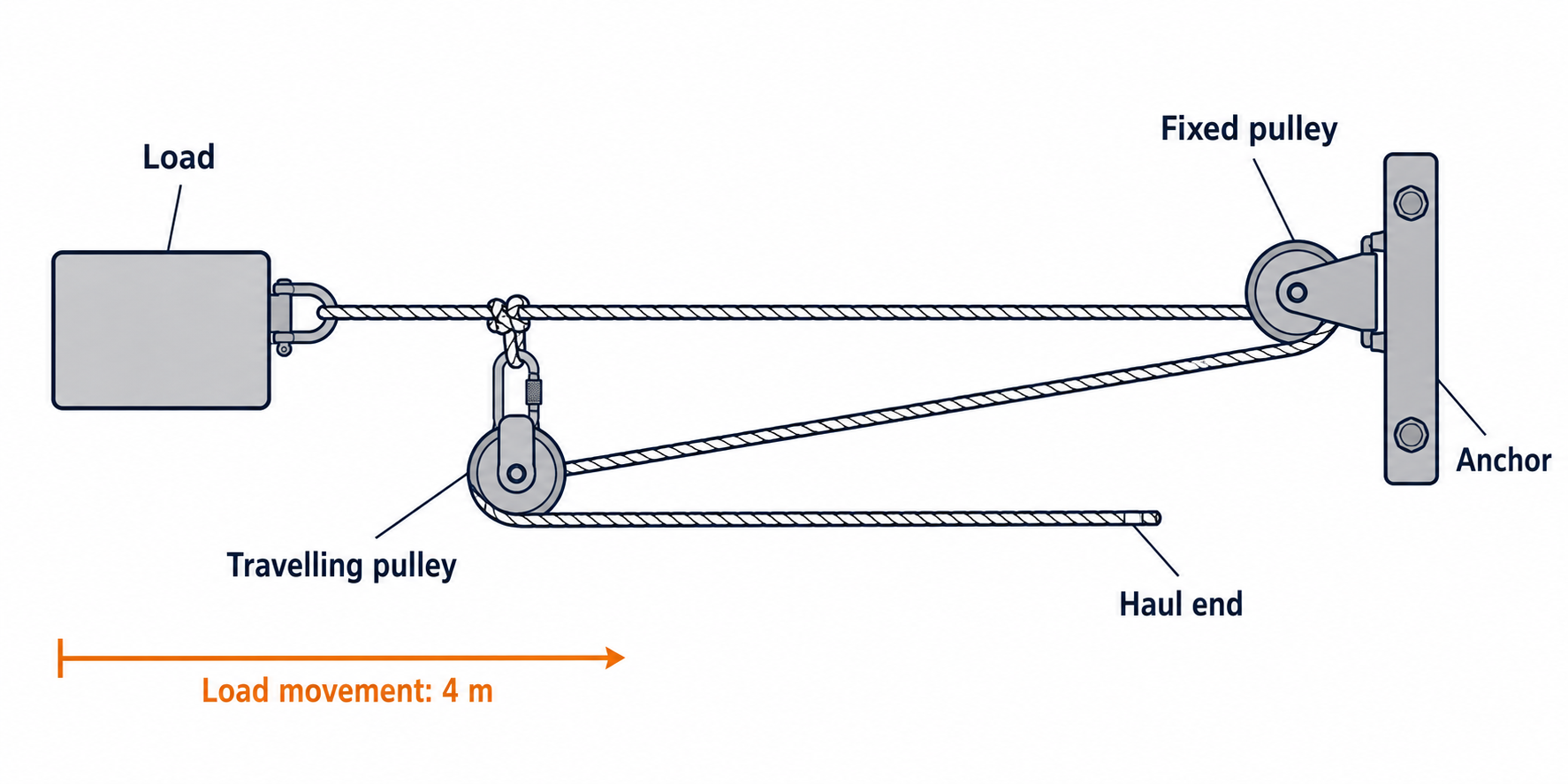
- A9 metres
- B12 metres
- C15 metres
- D18 metres
- A80 N
- B100 N
- C128 N
- D256 N
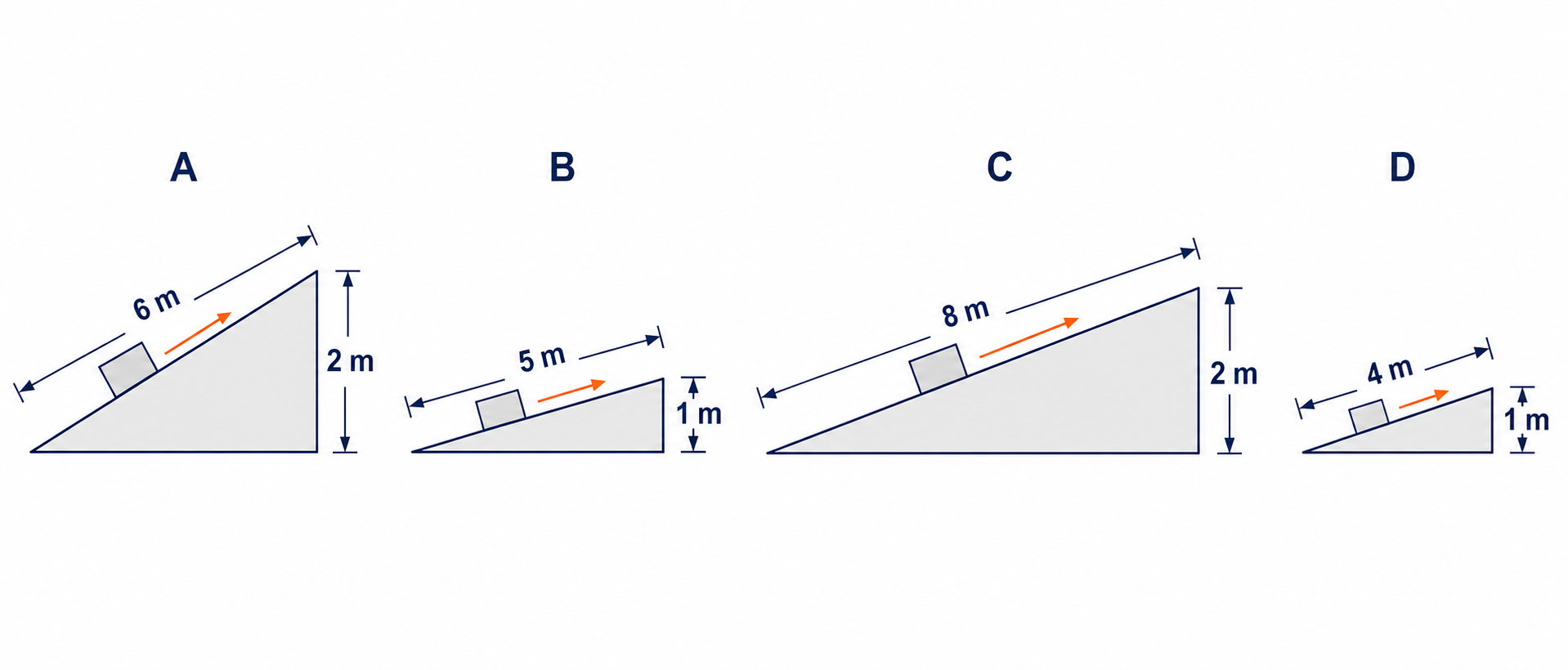
- ARamp A
- BRamp B
- CRamp C
- DRamp D
Practise 700+ Real FACT & CPS Questions
Try a free timed practice test, or unlock every full-length CPS and FACT test with explanations on every question.
Common Mistakes on Mechanical Aptitude Questions
Here are the errors that cost candidates the most marks:
- Using the **gear ratio backwards**
- Confusing **force reduction with distance travelled**
- Using the **wrong distance from the fulcrum** in lever questions
- Ignoring **efficiency or friction** when the question mentions it
- Not paying attention to the **timer**
- Making **arithmetic mistakes** under pressure
- Rushing through diagrams without identifying the **driver and driven** components
- Not practising enough questions with **different wording and variables**
A good strategy is to slow down just enough to ask four questions before you calculate:
- What is the **input**?
- What is the **output**?
- Am I solving for force, speed, direction, or distance?
- Which formula actually fits this setup?
How to Improve Your Mechanical Aptitude for the CPS Test
The best way to improve is to practise the exact question types that appear on firefighter aptitude tests. Focus on:
- Levers and torque
- Gears and direction of rotation
- Pulley systems and mechanical advantage
- Ramps and inclined planes
- Applied math under time pressure
You don't need dozens of formulas. You need a strong grasp of the core patterns and enough repetition that the process becomes automatic.
Final Thoughts
Mechanical aptitude can be one of the most intimidating parts of the CPS firefighter test, but it becomes far more manageable once you know the main rules. Start by learning rate/time/distance, levers, ramps, pulleys, gears, percentages, and basic algebra — then practise with realistic questions until you can solve them quickly and confidently.
Keep reading: What's Actually on the CPS Firefighter Test? · Ontario Firefighter Practice Test Guide: FACT vs. CPS · How to Pass the OFAI FACT Test · Free Practice Test · Premium Access & Pricing
Does the CPS firefighter test include mechanical aptitude?
CPS HR publishes several firefighter test versions and the section mix varies, so mechanical reasoning appears on some versions and not others. Always confirm the current format with the department you're applying to. Note that the OFAI FACT does not include a mechanical aptitude section.
Do I need a physics or trades background?
No. Mechanical aptitude questions test fundamentals — levers, gears, pulleys, ramps and basic force-and-distance trade-offs — that you can learn through practice and explanations.
What formulas should I memorize?
Rate/time/distance, the lever rule (E x ED = R x RD), the ramp rule (E x L = R x H), pulley mechanical advantage (effort = load / MA), the gear formula (driver RPM x driver teeth = driven RPM x driven teeth), and percentage change.
Why do I keep getting gear direction questions wrong?
Most errors come from jumping straight to the last gear. Trace the train one link at a time: meshing gears and crossed belts reverse direction, while open belts and same-shaft gears preserve it.
How can I practise mechanical aptitude questions?
Firefighter Academy includes mechanical reasoning questions inside its full-length CPS practice tests, with a written explanation on every question and timed simulation mode.