
Alberta firefighter aptitude preparation · Updated October 2026
CPS Practice Test:
Alberta Firefighter Test Prep
Prepare for firefighter aptitude testing with original CPS-style questions, timed practice and step-by-step explanations. Build your math, reading, mechanical and memory skills, then use your results to decide what to study next. Start with the free questions below.
Original CPS-style questions. Firefighter Academy is not affiliated with CPS, any testing provider or municipality.
Applying in Alberta? Confirm the test named in your recruitment posting before choosing a study plan. Test sections, calculator rules and passing requirements must be checked with your department; Ontario FSO requirements are not an Alberta standard.
TRY SAMPLE CPS QUESTIONS
Choose a category and tap an answer to get instant feedback and a clear explanation — using the same testing format as the full platform. No signup required.
A pump is operating at 2,200 RPM. If the pump speed is increased by 15%, at what RPM is the pump now operating?
Read the sample questions as text
Reading Comprehension
Firefighters use a variety of ropes and knots for rescue, hoisting equipment, and securing loads. Ropes are classified by their construction and intended use. Life-safety rope is used exclusively for supporting human weight and must meet strict standards for strength and reliability. Utility rope is used for hoisting tools, cordoning off areas, and securing equipment, but is never used for life-safety applications once it has been used for a utility purpose. The tensile strength of a rope decreases significantly when a knot is tied in it. Most knots reduce the effective strength of a rope by 30 to 50 percent at the point of the knot, due to the tight bending radius creating stress concentrations in the fibres. For this reason, rope systems used in rescue operations are designed with a safety factor — meaning the rope is rated to hold several times the expected load. The bowline knot is widely used in fire service because it creates a fixed loop that will not slip under load and can be untied relatively easily even after bearing weight. The figure-eight follow-through is considered one of the strongest knots for attaching a rope to an anchor point.
A rope originally purchased as life-safety rope is used for several months to hoist tools. It later passes a visual inspection. Based on the passage, how should it be classified for a victim-lowering operation?
- It may be restored to life-safety use because inspection confirms that no damage is visible
- It may support a person only if no knot is tied in the loaded section
- It may be used as the backup line but not as the main line
- It must remain utility rope because prior utility use excludes it from later life-safety service
Reading Comprehension
Firefighters use a variety of ropes and knots for rescue, hoisting equipment, and securing loads. Ropes are classified by their construction and intended use. Life-safety rope is used exclusively for supporting human weight and must meet strict standards for strength and reliability. Utility rope is used for hoisting tools, cordoning off areas, and securing equipment, but is never used for life-safety applications once it has been used for a utility purpose. The tensile strength of a rope decreases significantly when a knot is tied in it. Most knots reduce the effective strength of a rope by 30 to 50 percent at the point of the knot, due to the tight bending radius creating stress concentrations in the fibres. For this reason, rope systems used in rescue operations are designed with a safety factor — meaning the rope is rated to hold several times the expected load. The bowline knot is widely used in fire service because it creates a fixed loop that will not slip under load and can be untied relatively easily even after bearing weight. The figure-eight follow-through is considered one of the strongest knots for attaching a rope to an anchor point.
A team must choose between a bowline and a figure-eight follow-through for a primary attachment to an anchor. Ease of untying is secondary to maximizing attachment strength. Which choice best follows the passage?
- Use the figure-eight follow-through because the passage identifies it as one of the strongest anchor-attachment knots
- Use the bowline because every fixed-loop knot retains more strength than a follow-through knot
- Use either knot because all knots reduce rope strength by the same amount
- Avoid both knots because an anchor attachment should never contain a knot
Math
A pump is operating at 2,200 RPM. If the pump speed is increased by 15%, at what RPM is the pump now operating?
- 2,420 RPM
- 2,530 RPM
- 2,630 RPM
- 2,215 RPM
Answers and step-by-step explanations appear in the interactive practice module above once you choose an option.
Learn the concepts. Practice the questions. Know what to study next.
Explore study lessons, apply what you learn, and review your practice results. All within Firefighter Academy.
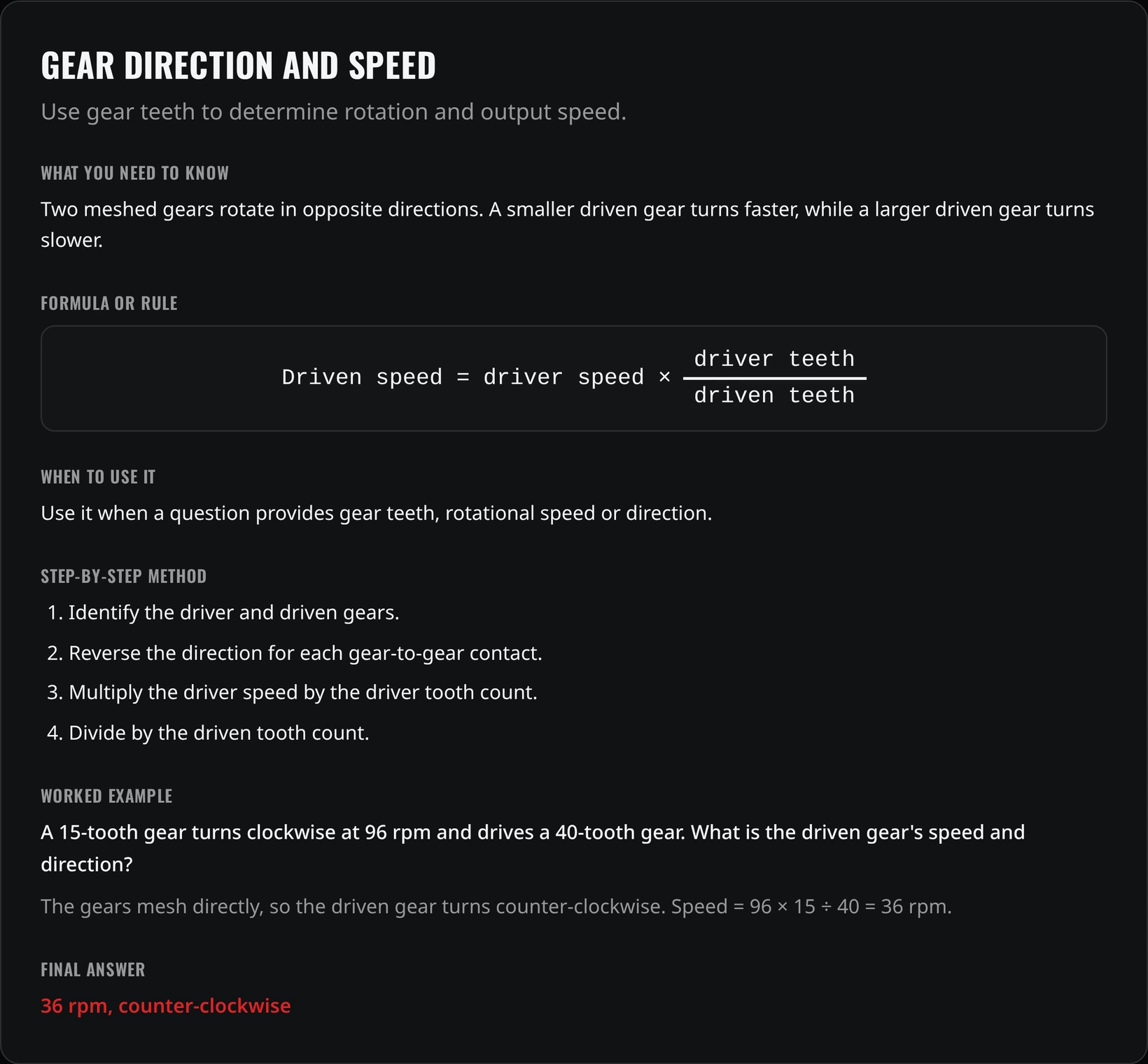
Learn the method
Build your understanding with theory, formulas, step-by-step methods, and worked examples.
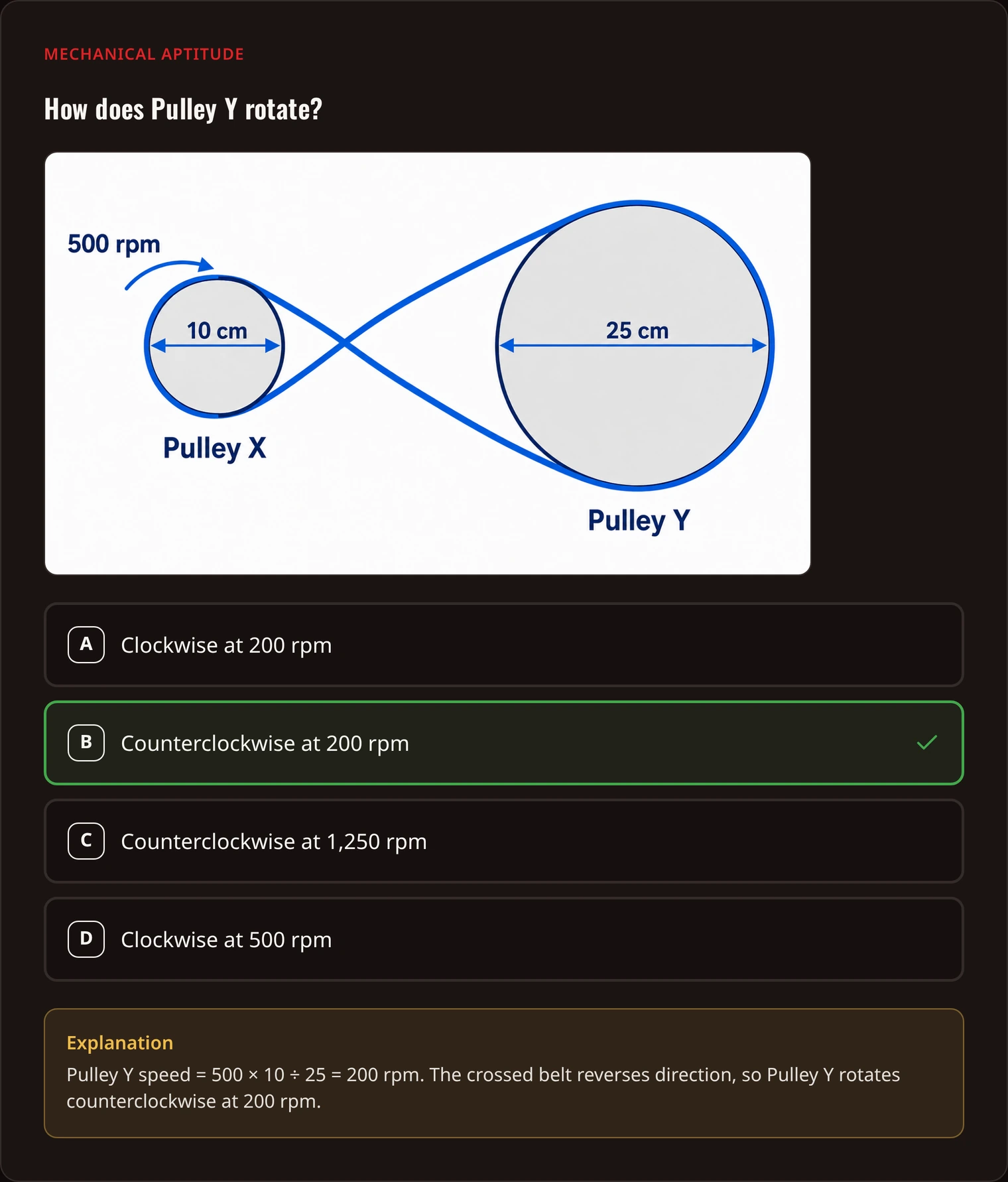
Practice with explanations
Apply what you’ve learned to exam-style questions, then review explanations that walk you through the answer.
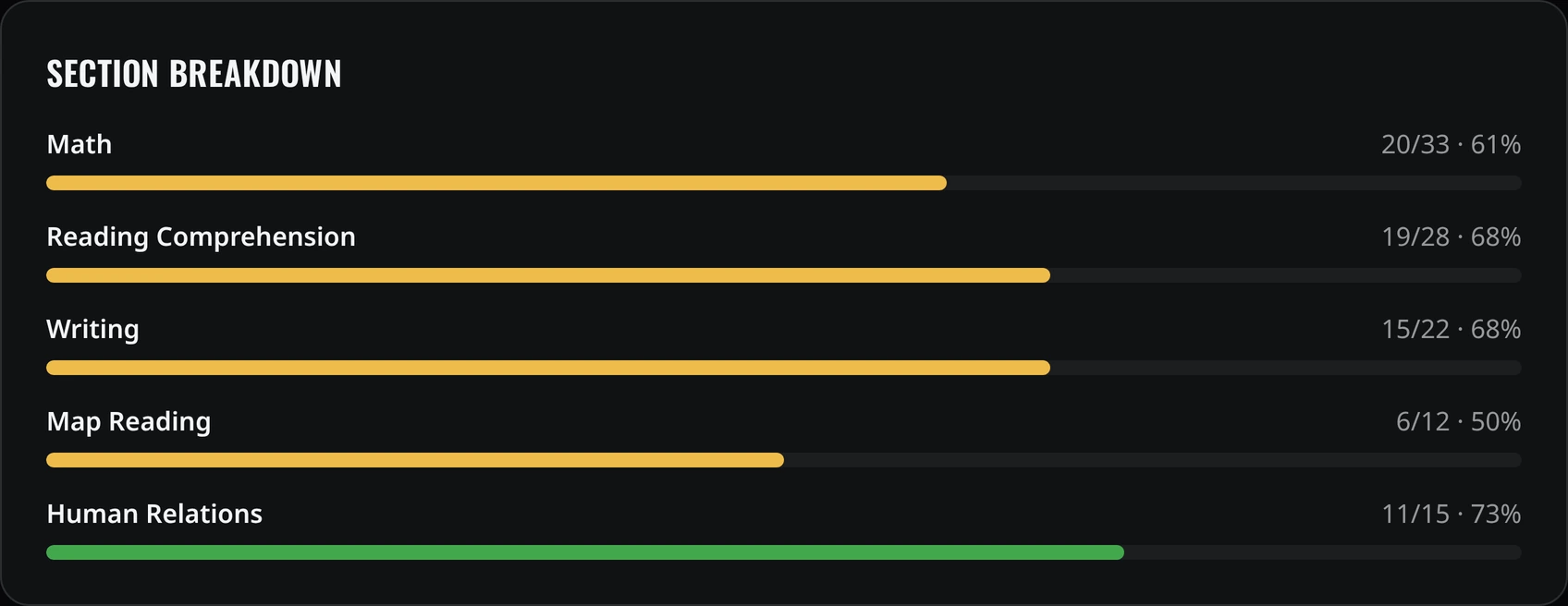
Know where to focus
See your performance by section and identify the areas that need more practice.
Overview
What is the CPS firefighter test?
CPS firefighter aptitude testing assesses how you understand information and solve problems. Preparation means learning repeatable methods for calculations, reading, diagrams and recall, then applying them under time pressure.
This Alberta guide combines CPS-style practice with local recruitment context. Always use your department’s current posting and test invitation to confirm the assessment you will write.
Alberta
Preparing for Edmonton firefighter recruitment
Edmonton’s recruitment page directs applicants to CPS HR preparation materials. Its listed aptitude areas cover listening, reading, numerical ability, maps and diagrams, mechanical reasoning, teamwork and public speaking.
The published process assigns 40% of the overall candidate score to aptitude testing. Edmonton also says its process is being updated for the 2027 intake, so check the finalized guidelines before relying on earlier requirements.
Use Firefighter Academy to practise the underlying skills and review mistakes. Our CPS practice bank is shared across regions; it is not a separate Edmonton examination. Do not assume another Alberta department uses the same assessment.
Sections
What to expect on a CPS firefighter test
Focus on accuracy first, then speed. Our practice material covers reading comprehension, applied math, mechanical reasoning and oral-information recall, with additional map and human-relations exercises. Use the confirmed section list for your recruitment to prioritize your study time.
Memory and oral information
A CPS test may include an oral-information section. In the format many applicants encounter, it comes first: you listen to a passage for roughly five minutes and answer questions about it later.
You may need to remember:
- Names
- Numbers
- Locations
- Sequence of events
- Descriptions
- Operational details
Our memory exercises train you to pick out the details most likely to matter instead of trying to memorize every word. The name and format of this section can vary, so check your test instructions.
Reading comprehension
Expect both short and long reading passages. Some are fire-related and some are not. The test is checking whether you can pull the right details from unfamiliar material.
- Firefighter-related informational passages
- Reports or policy-style material
- Short operational scenarios
- Complex passages in a field unrelated to firefighting
- Longer passages containing several relevant details
Questions can test:
- Main idea
- Specific details
- Sequence
- Conclusions supported by the passage
- Vocabulary in context
Base your answer only on the passage. An option can sound reasonable and still be wrong if the text does not support it.
Mathematical ability
You will do the calculations by hand, so speed matters. Know your multiplication and division well enough that the basic steps do not eat up the clock.
- Addition and subtraction
- Multi-digit multiplication
- Long division
- Fractions
- Decimals
- Percentages
- Ratios and proportions
- Unit conversions
- Basic applied algebra and solving for an unknown
- Distance, time and rate
- Flow rate, volume and time
- Capacity, quantity and remaining-amount word problems
Math formulas to know
- Rate = Distance ÷ Time
- Distance = Rate × Time
- Time = Distance ÷ Rate
- Volume = Flow Rate × Time
- Time = Volume ÷ Flow Rate
- Percentage = (Part ÷ Whole) × 100
- Part = (Percentage ÷ 100) × Whole
- Average = Total ÷ Number of values
- Proportion: a ÷ b = c ÷ d, so a × d = b × c
- Solve for x: a ÷ b = c ÷ x, so x = (b × c) ÷ a
- Converted value = Original value × Conversion factor
For a proportion, multiply across the diagonals first, then divide to isolate the missing value. For example, if 3 ÷ 5 = x ÷ 20, then 5x = 60 and x = 12.
Here, algebra usually means finding one unknown in a simple equation. You do not need advanced algebra.
Practical tips
- Write your steps clearly on scrap paper.
- Estimate the expected answer before calculating.
- Check whether the question asks for a total, difference, rate, time or remaining amount.
- Practice until multiplication and division feel automatic.
Want targeted drills? Work through the firefighter math practice test because the arithmetic demands overlap almost entirely.
Mechanical aptitude
Most mechanical questions are less about technical knowledge and more about recognizing what the diagram shows. Learn the basic principles, then use the drawing to work out direction, force or mechanical advantage.
- Levers and fulcrums
- Effort arm and load arm
- Mechanical advantage of a lever
- Inclined planes and ramps
- Pulley systems
- Gear direction and gear ratios
- Wheel-and-axle principles
- Torque
- Basic force and pressure relationships
- Interpreting mechanical drawings
Mechanical formulas to know
- Lever balance: Effort × Effort Arm = Load × Load Arm
- Lever MA = Effort Arm ÷ Load Arm
- Effort Required = Load ÷ Mechanical Advantage
- Ramp MA = Ramp Length ÷ Ramp Height
- Pulley MA = Number of supporting rope sections
- Gear Ratio = Driven Gear Teeth ÷ Driver Gear Teeth
- Output Speed = Input Speed ÷ Gear Ratio
- Torque = Force × Perpendicular Distance
- Wheel-and-Axle MA = Wheel Radius ÷ Axle Radius
- Pressure = Force ÷ Area
- Force = Pressure × Area
Do not memorize individual answers. Learn what changes when an arm gets longer, a gear gets larger or a load moves closer to the fulcrum.
Practice mechanical aptitude questions.
Maps and diagrams
Map questions test whether you can follow a visual accurately under time pressure.
- Street grids
- Compass directions
- Intersections
- Following a described route
- Identifying the correct or shortest route
- Tracking turns and changes in direction
- Reading building diagrams or mechanical drawings
- Locating features using a legend
Follow the question's exact instructions. "Shortest route" and "correct route" are not the same question, and a single missed one-way street or reversed compass direction changes the answer.
Firsthand
What test day can actually feel like
Read your test invitation closely. Confirm the format, timing, identification requirements, permitted materials and rules for breaks or note-taking. Follow the instructions supplied for your assessment.
If your test is online, complete any required equipment checks, confirm your internet connection and prepare the testing space as instructed. If it is in person, plan your travel and arrival time.
During practice, work in timed sessions without interruptions. Use the permitted tools and conditions described in your invitation whenever possible.
Why this matters
- Reading details are easier to miss when you are tired.
- Basic arithmetic can feel slower under pressure.
- You still have to absorb and follow a new set of instructions.
Prepare for a long testing day
- Do some timed practice after a normal school or work day, not only when you feel perfectly rested.
- Make basic arithmetic as automatic as possible.
- Use the same organized scrap-paper layout every time.
- Build up to longer mixed-question sets.
- Follow the food, water, clothing and arrival instructions for your booking.
You do not need to exhaust yourself before a practice test. The goal is simply to get comfortable concentrating for longer periods.
Results
What score do you need to pass the CPS aptitude test?
Check the passing requirement and selection rules for your specific recruitment. The 70% figure used by Firefighter Services of Ontario should not be treated as an Alberta-wide cutoff.
Use practice scores to identify weak areas and track improvement. A Firefighter Academy result does not predict an official examination score or guarantee advancement. Aim for consistent accuracy across your required subjects.
Preparation
How to prepare
- 1Confirm the test provider, assessed subjects and current instructions for your Alberta recruitment.
- 2Try the free CPS questions, then take a mixed practice test to establish your starting point.
- 3Use your section results to identify the subjects costing you the most marks.
- 4Practise multiplication, long division, fractions, percentages, ratios and unit conversions on paper.
- 5Learn how levers, pulleys, gears and belts work so you can reason through unfamiliar diagrams.
- 6Read unfamiliar passages and choose answers supported by the text.
- 7Practise recalling names, numbers, locations and event sequences from spoken information.
- 8Include map reading and human-relations practice when relevant to your confirmed test.
- 9Review explanations and revisit missed questions until you can explain the method yourself.
- 10Complete timed mixed sessions and check your test-day instructions again before the assessment.
Week 1
Learn the methods and formulas
Build the foundation: no-calculator arithmetic, rates, mechanical-advantage formulas, reading strategies, map skills and a reliable approach to oral-information recall.
Week 2
Apply them in practice tests
Complete mixed practice tests, review every explanation and keep a simple error log. Spend extra time on the sections costing you the most marks.
Week 3
Increase speed and handle pressure
Move into timed sets and longer mixed sessions. Practice making accurate decisions faster while staying organized when questions become more demanding.
Week 4
Refine and simulate
Complete full simulations, correct recurring mistakes and revisit only the formulas or question types that still slow you down. Keep the final day light.
Pitfalls
Common mistakes
- Assuming every Alberta department uses the same test.
- Applying Ontario passing scores or testing schedules to an Alberta recruitment.
- Practising only the subjects you already find easy.
- Memorizing answers instead of learning how to solve the question.
- Rushing through passages or overlooking units in math problems.
- Repeating tests without reviewing your missed questions.
- Leaving test instructions or online equipment checks until the last minute.
Comparison
CPS vs FACT
Make sure you are studying for the test named in your posting. CPS and FACT overlap in a few areas, but they are not the same exam.
CPS
- Administered by the department or its chosen testing provider
- Exact format can vary by recruitment
- Reading, math, mechanical aptitude, maps/diagrams and oral-information recall may appear
- Passing standard set by the testing provider
- Calculator typically not permitted
- Numeric performance may matter to the hiring department
FACT
- Fixed published 110-question structure
- Up to three hours
- Reading, mathematical reasoning, map reading, writing and personal characteristics
- Passing standard set by the testing provider
- No dedicated mechanical aptitude or memory section
Full preparation
Your full access
The sample questions show you what to expect. Full access gives you 350+ CPS-style questions, timed tests, explanations for every answer and analytics that show where you are losing marks.
Questions
Frequently asked questions
Is this CPS practice test free?
Yes. You can answer the sample questions on this page without an account or credit card. A free account unlocks a longer practice test and saves your results.
Does Edmonton use CPS firefighter testing?
Edmonton’s recruitment page links to CPS HR study resources. Check the current recruitment guidelines and your invitation for confirmed test details, especially while the 2027 process is being updated.
Does every Alberta fire department use CPS?
Choose your preparation based on the test named in each department’s current posting. Do not assume one municipality’s requirements apply across Alberta.
Are these official CPS or Edmonton test questions?
No. These are original practice questions. Firefighter Academy is an independent preparation platform and is not affiliated with CPS HR, Edmonton Fire Rescue Services or any municipality.
Is there a separate Alberta question bank?
The CPS practice bank is shared across regions. This page adds Alberta recruitment guidance; it does not provide a separate provincial exam or reproduce a department’s live test.
What math should I practise?
Work on multiplication, long division, fractions, decimals, percentages, ratios, unit conversions and applied word problems. Learn to identify the required calculation before solving it.
How can I improve mechanical reasoning?
Learn the principles behind levers, pulleys, gears, belts, ramps and pressure. Use diagrams to follow forces or rotational direction, then review the explanation for every mistake.
How should I practise memory questions?
Listen to a short passage and recall its names, numbers, locations and sequence of events. Use the explanations to identify which details you overlooked. Follow your actual test’s rules about notes and replaying audio.
Can I use a calculator?
Follow your testing provider’s current instructions. Practising calculations by hand builds fluency, but this guide should not replace the calculator rules supplied for your assessment.
Do I need 70% to pass in Alberta?
Do not assume that. The 70% requirement referenced in Ontario FSO guidance is not an Alberta-wide passing standard. Confirm the requirement for your recruitment.
How long should I study?
Start with a practice test and let your results guide the schedule. Use short, regular sessions to learn weak concepts, review mistakes and build speed. Allow time for timed practice before test day.
What does full access include?
Full access includes the CPS and FACT practice banks, timed simulations, explanations, study resources, progress tracking and missed-question practice. Check the pricing page for the current offer.
Transparency
Sources and methodology
Reviewed October 7, 2026. Alberta recruitment context was checked against the City of Edmonton firefighter recruitment page: https://www.edmonton.ca/city_government/jobs/firefighter-recruitment
Requirements can change. The current recruitment posting, finalized guidelines and your test invitation take precedence over this guide.
Practice questions are original educational material, not official examinations. Firefighter Academy is independent and is not affiliated with CPS HR, Firefighter Services of Ontario, OFAI or any municipality.